Which Chair Mechanism Is Right For Me?
Introduction
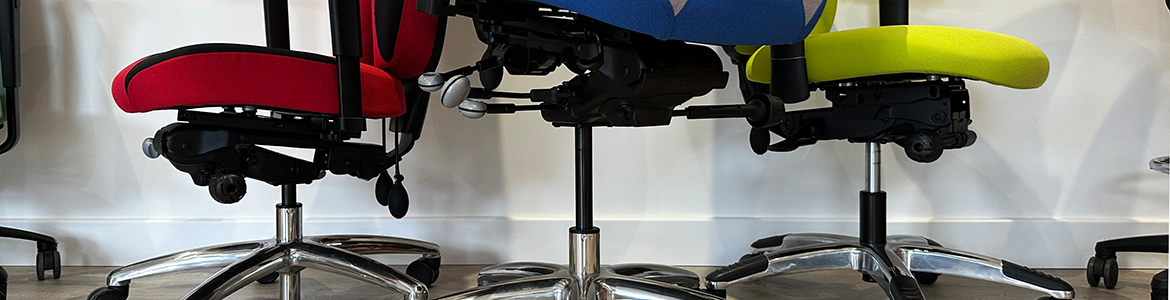
When choosing an ergonomic office chair, it can be easy to focus on appearance, materials or brand. However, one of the most important factors is often hidden underneath the seat: the chair mechanism. The mechanism controls how a chair moves, reclines and supports the user, and is a key reason why ergonomic chairs vary considerably in price.
Under the UK’s Health and Safety (Display Screen Equipment) Regulations 1992, chairs must allow users to achieve a comfortable working posture through adjustable seat heights and backrests. Modern ergonomics takes this further by encouraging active seating - the habit of regularly alternating positions rather than remaining static. Small movements such as changes in seat angle and adjustments to the way the body is supported can help users maintain comfortable working positions throughout the day.
This is where chair mechanisms become particularly important. Generally speaking, the more movement and adjustability a mechanism provides, the more complex and expensive the chair will be. However, more advanced is not always better for everyone. As an example, an individual with no history of joint or back issues might only need a simple, adjustable chair, whereas someone managing chronic musculoskeletal (MSK) pain may require maximum support and freedom of movement.
Ultimately, there is not a single “best” mechanism. The trade-off is between support, freedom of movement, adjustability and cost. This blog explores the three main types of ergonomic chair mechanisms, how they work and how they benefit the user.
Multi-Tilt Mechanisms
A Multi-Tilt Mechanism is a simple chair mechanism that provides several independent adjustments, allowing the chair to be configured to suit the individual user. It is commonly found on more budget-conscious ergonomic chairs, but cover all fundamental health and safety requirements, allowing you to set up a customised, supportive posture without paying for complex motion features.
Multi-Tilt Mechanisms are found in chairs such as: Best Home Working Chair, BC One, BC Two, Adapt 500 range and Opera 60 range.
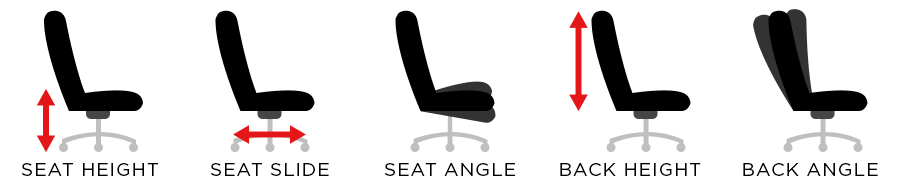
The exact functions vary between manufacturers and models, but a Multi-Tilt Mechanism such as the one used on the Opera 60 can provide:
- Seat height – the whole chair can be raised or lowered to suit the user and their desk
- Seat slide – the seat pad can move forwards and backwards, allowing the user to adjust the seat depth to suit their leg length
- Seat angle – the angle of the seat can be adjusted to change the position of the pelvis and the relationship between the hips and knees. Generally, the seat angle must be fixed into place once adjusted and does not offer a float / rocking action
- Back angle – the backrest can be angled to provide a more upright or reclined sitting position
- Back height – the backrest can be moved up or down so that the lumbar area and other parts of the backrest are positioned appropriately for the individual user
These adjustments work together to ensure the user is set up to use the chair comfortably. A well-designed chair with Multi-Tilt Mechanism can provide the fundamental adjustments needed to establish a comfortable working position. HSE guidance identifies seat height, backrest height and backrest tilt as important seating adjustments. It also recognises that chairs can provide different combinations of seat and backrest movement.
The main advantage of a simpler mechanism is value. It provides a useful level of adjustability without the additional cost or complexity of a more advanced mechanism. For an office user who needs to establish the correct seat height, position the backrest and adjust the seat depth, a Multi-Tilt Mechanism can provide a practical and effective solution.
Synchro Mechanisms
A Synchro Mechanism is design to co-ordinate the moment of the seat pad and backrest when the user reclines. Rather than the seat and backrest moving independently, they move together in a controlled relationship. This provides a more fluid rocking and reclining action, while allowing the chair to follow the user’s movement.
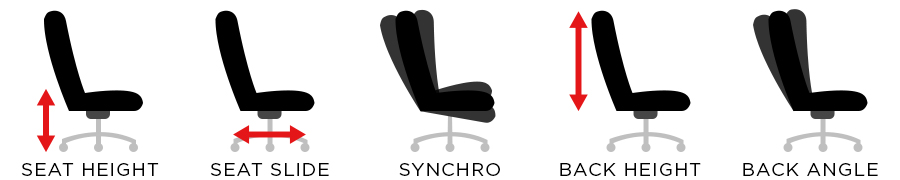
Synchro Mechanisms are found in chairs such as BC 100 and BC 200 and can provide:
- Seat height – the whole chair can be raised or lowered to suit the user and their desk
- Seat slide – the seat pad can move forwards and backwards, allowing the user to adjust the seat depth to suit their leg length
- Synchro rocking action – the seat and backrest move together as the user reclines, maintaining a co-ordinated relationship between the two
- Back height – the backrest can be moved up or down so that the lumbar area and other parts of the backrest are positioned appropriately for the individual user
- Back angle – the backrest can be angled to provide a more upright or reclined sitting position
The key difference between a Synchro Mechanism and a Multi-Tilt Mechanism is how the seat and backrest move when reclining. With a Multi-Tilt Mechanism, these can typically be adjusted independently, whereas a Synchro Mechanism links their movement. As the user reclines, the seat and backrest move together in a controlled relationship, allowing the chair to follow the user’s movement and maintain support.
This coordinated movement allows users to change position more naturally throughout the working day, moving from a more upright position to a reclined one while remaining supported. Additional adjustments, such as back height and seat slide, allow the chair to be fitted to the individual user.
Overall, a Synchro Mechanism provides a combination of movement, support and adjustability, with the exact level of functionality varying between mechanisms and models.
Semi-Knee Tilt Mechanisms (also known as Central or Midway Knee-Tilt Mechanism)
A Semi-Knee Tilt Mechanism is a mid-level chair mechanism that provides a rocking action and greater freedom of movement than a Multi-Tilt Mechanism. It sits between a simpler Multi-Tilt Mechanism and a more advanced Full Knee-Tilt Mechanism, offering additional movement without the complexity and cost of a premium mechanism.
Semi-Knee Tilt Mechanisms are found in chairs such as Opera 30 range, Opera 50 range and Adapt 600 range.
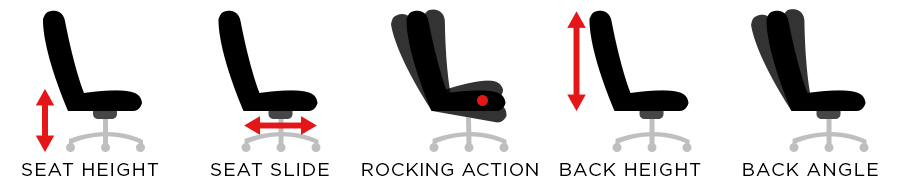
The exact functions vary between manufacturers and models, but a Semi-Knee Tilt Mechanism such as the one used on the Opera 30 can provide:
- Seat height – the whole chair can be raised or lowered to suit the user and their desk
- Seat slide – the seat pad can move forwards and backwards, allowing the user to adjust the seat depth to suit their leg length
- Rocking action – the mechanism allows the user to rock between a more upright and reclined position
- Back angle – the backrest can be angled to provide a more upright or reclined sitting position
- Back height – the backrest can be moved up or down so that the lumbar area and other parts of the backrest are positioned appropriately for the individual user
These adjustments work together to ensure the user is set up to use the chair comfortably. The reference to “knee” indicates where the rocking pivot point is in relation to the knee.
A semi-knee tilt or midway knee tilt mechanism means that the pivot point is halfway (semi) between the centre of the seat and the front edge / knee. This results in the front edge of the seat rising only a small amount, allowing the user’s feet to remain in contact with the floor while rocking or reclining. This provides a stable point of contact and enables the user to move between different sitting positions while maintaining contact with the floor.
The main advantage of this mechanism is the greater freedom to move and vary posture during the working day. Rather than remaining in a fixed upright position, the user can rock and recline the backrest as required. This can be particularly useful during longer periods of desk work. A user may prefer a more upright position when concentrating on a task, then recline slightly when reading, taking a call or carrying out less intensive work.
Overall, a Semi-Knee Tilt Mechanism provides a useful balance between movement, adjustability and cost. It offers more freedom of movement than a basic mechanism while remaining more affordable and less complex than a Full Knee-Tilt Mechanism.
Full Knee-Tilt Mechanisms
A Full Knee-Tilt Mechanism is a more advanced chair mechanism designed to provide a greater range of movement when rocking, reclining or tilting. It is typically found on more premium ergonomic chair ranges, where greater movement and support are important features.
Full Knee-Tilt Mechanisms are found in chairs such as Opera 20 range, RH Logic range and RH New Logic range.
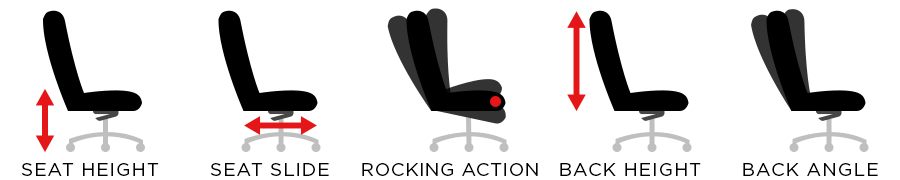
The exact functions vary between manufacturers and models, but a Full Knee-Tilt Mechanism such as the one used on the Opera 20 can provide:
- Seat height – the whole chair can be raised or lowered to suit the user and their desk
- Seat slide – the seat pad can move forwards and backwards, allowing the user to adjust the seat depth to suit their leg length
- Rocking action – the mechanism allows the user to rock between a more upright and reclined position. The range of motion would be greater than that of the Semi-Knee Tilt Mechanisms as the pivot point is at the front of the seat / right behind your knees. This ensures minimal seat lift when reclining and, in the case of Opera 20 and RH Logic chairs, even provides a slight forward tilt to assist when getting out of the chair. Knee-tilt mechanisms provide a much smoother rocking action and ensure there is no pressure from the seat on the underside of your thighs when rocking
- Back height – the backrest can be moved up or down so that the lumbar area and other parts of the backrest are positioned appropriately for the individual user
- Back angle – the backrest can be angled to provide a more upright or reclined sitting position
These adjustments work together to ensure the user is set up to use the chair comfortably. The key difference between a Full Knee-Tilt and Semi-Knee Tilt Mechanism is the range of movement and reduced pressure on the underside of the thighs when rocking with a knee-tilt mechanism.
As the user reclines, the seat and backrest move with them, maintaining support throughout the movement. This type of movement is sometimes described as a “floating”, “free-float” or “rocking” mechanism. The user can move through a larger range of positions while the chair follows and supports their movement, whilst feet remain in contact with the floor.
The main advantage is the larger range of movement, which allows the user to move between upright and reclined positions more freely. For example, they may use a more upright position when concentrating on detailed work and then recline when reading or attending a long meeting for example. In these scenarios, adding a neck or head rest would be an appropriate optional extra to the chair, to ensure the user is as comfortable as possible.
Overall, a Full Knee-Tilt Mechanism provides a greater level of movement, support, comfort and adjustability, making it particularly suited to premium ergonomic chairs and users who value a wider range of reclining and rocking positions.
The trade-off is greater complexity and cost. For users who do not need a large range of movement, a Semi-Knee Tilt Mechanism or Multi-Tilt Mechanism may provide sufficient adjustment. For those who benefit from greater freedom to move between upright and reclined positions while remaining fully supported and comfortable, a Full Knee-Tilt Mechanism provides additional functionality.
Industry Standards
When considering the quality and safety of an ergonomic office chair, it is also useful to understand the industry standards against which chairs can be tested. These standards set requirements for areas such as safety, strength, stability and durability, helping to ensure that a chair is suitable for its intended use and does not present an avoidable risk to the user.
BS EN 1335-2:2018 is the European standard for the safety requirements of office work chairs. It specifies requirements for safety, strength and durability, with the requirements based on use for up to 8 hours per day by people weighing up to 110 kg.
BS 5459-2:2000+A2:2008 covers office pedestal seating for use by people weighing up to 150 kg and for use for up to 24 hours per day. It specifies requirements and test methods covering areas including structural safety, stability, durability and the performance of individual components such as bases, columns, seat mechanisms, back stems and locking devices. The standard is particularly relevant to chairs intended for intensive use, such as 24-hour environments or applications where higher user weights need to be accommodated.
These standards provide an indication that the chair has been designed and tested against defined requirements for safety, strength and durability. It is important to note that meeting an industry standard does not determine whether a chair is suitable for every individual or working environment. User requirements, hours of use and the intended application should still be considered when selecting a chair. However, these standards provide an important benchmark for the safety and performance of office seating.
Summary Table
Choosing a chair mechanism comes down to balancing support, freedom of movement, and budget.
| Mechanism | Movement Level | Key Advantage | Ideal Choice For | Example Chair Ranges |
| Multi-Tilt | Low, but with independent adjustments - no rocking action | Excellent value, whilst still providing adjustability | Standard desk work, smaller budgets | Opera 60, BC One, BC Two, Best Home Working Chair, Adapt 500 |
| Synchro | Moderate, seat and backrest move together when reclining | Smooth, coordinated movement whilst maintaining support | Users who want greater movement and reclining without moving to a full knee-tilt mechanism | BC 100, BC 200 |
| Semi-Knee Tilt | Moderate, Midway pivot rocking – front of seat raises slightly whilst rocking | Keeps feet flat on the floor, whilst allowing movement | Users who want gentle rocking, postural freedom, mid-size budgets | Opera 50, Opera 30, Adapt 600 |
| Full Knee Tilt | High, fluid floating motion - font of seat raises minimally when rocking | Dynamic support across deep reclines | Premium, comfort, maximum movement, larger budgets | Opera 20, RH Logic |
Conclusions
Chair mechanisms play an important role in determining how an ergonomic chair moves, how it supports the user and how much adjustment it provides.
Multi-tilt mechanisms provide essential adjustability, Semi-Knee Tilt Mechanisms introduce greater freedom of movement through their rocking action, and Full Knee-Tilt Mechanism provide the greatest range of movement and support when reclining.
As mechanisms become more advanced, chairs generally become more complex and expensive. However, a more expensive mechanism is not necessarily better for every user. The most suitable option depends on the individual's requirements, working habits and the level of movement and adjustment they need. A simpler mechanism may provide everything one user requires, while another may benefit from the additional functionality of a more advanced mechanism. The priority should therefore be choosing a chair that provides the appropriate level of adjustment and support, rather than simply selecting the most sophisticated mechanism available.
If you are unsure which mechanism is most suitable for your requirements, please contact us for advice.
Further Reading
https://www.legislation.gov.uk/uksi/1992/2792/schedule/made
https://www.hse.gov.uk/msd/dse/
https://knowledge.bsigroup.com/products/office-furniture-office-work-chair-safety-requirements
https://knowledge.bsigroup.com/products/specification-for-performance-requirements-and-tests-for-office-furniture-office-pedestal-seating-for-use-by-persons-weighing-up-to-150kg-and-for-use-up-to-24-hours-a-day-including-type-approval-tests-for-individual-components